Memory Passport is not part of the normal tenant-memory quickstart. If your application stores and retrieves context inside its own workspace, use one tenant API key and a stable
external_user_id; your users do not need a MemoryOS account or consent redirect.
Core objects
Universal user — created when someone registers or signs in through the consent app. MemoryOS maintains an agent-facinguui_... token for backend SDK calls. End users interact through the consent app via email + OTP, not raw tokens.
Global agent — an agent profile that can request Memory Passport access. Each has a public profile, a verification status, default requested categories, and an agent_sk_... API key for universal memory APIs.
Create one with:
id (public, safe for consent URLs) and raw_agent_api_key (one-time secret, store server-side immediately).
Permission grant — connects a user to an agent with a specific set of allowed categories, an access mode (read_only or read_write), and an optional expiry.
Connector - links a user’s account in another service to their Memory Passport. Connectors are useful when a company wants to prove “this Passport belongs to this signed-in customer” before sharing account-specific context.
There are two connector paths:
- OAuth connector - the user starts from MemoryOS Passport, authenticates with the service, and returns to MemoryOS.
- Secure-link connector - the user starts inside the company’s app, clicks Connect Memory Passport, and the company’s backend creates a one-time MemoryOS link for that signed-in user.
Category-scoped sharing
Grants are category-scoped. A user can approvepreference and expertise while withholding goal, relationship, fact, and procedure. The agent only sees what was explicitly approved.
Current categories: preference, fact, goal, procedure, relationship, expertise
Auth model
Universal memory calls require both headers:agent_sk_... identifies the agent. uui_... identifies the user. MemoryOS verifies an active grant exists for that pair and that the requested category is in categories_allowed.
Grant lifecycle
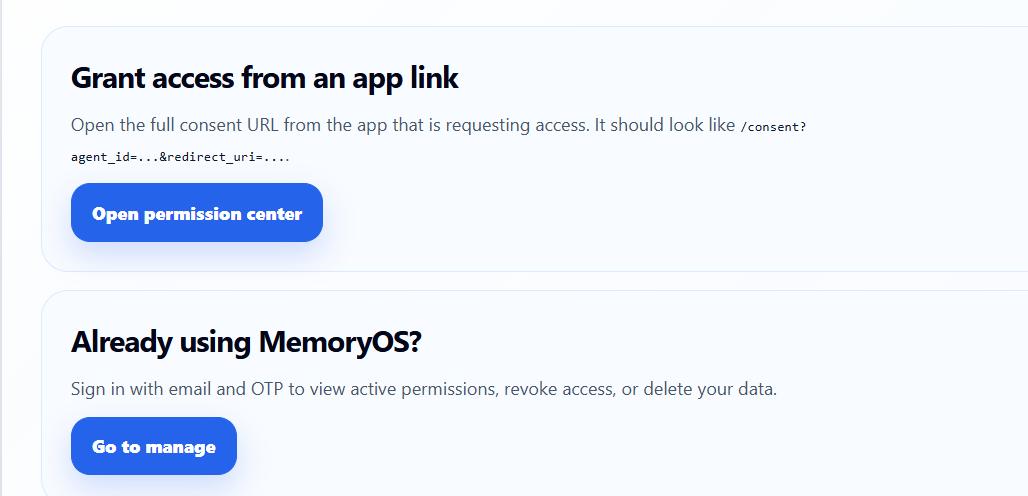
- App introduces MemoryOS and sends the user to a consent URL
- User authenticates via email + OTP (or resumes an active session)
- User approves categories, access mode, and duration
- Agent can read or write within the grant scope
- User can revoke at any time from the permission center
- Revocation removes future access — no data leaks on denial
Connector lifecycle
For a secure-link connector:- User signs in to the company’s app
- User clicks Connect Memory Passport
- Company backend calls
/v1/tenant/memory-passport/link-token - App redirects the user to
/connect?agent_id=...&link_token=... - MemoryOS verifies the one-time link and creates the connection
- User can disconnect the service from Passport later
Pending Questions
The permission center has a Pending Questions tab. This surfaces only personal conflicts MemoryOS routes back to the user — not all conflicts, just ones the user needs to resolve themselves.
When the user answers:
- Choose one version — the other is archived
- Both are correct — both memories remain active
- Neither is correct — clarification closed, neither confirmed
Privacy guarantees
- An agent cannot see which other agents were granted access
- Revoked grants return empty results, not errors
- Deleted Memory Passport removes all universal memories and active grants
- Universal memories are stored separately from tenant-scoped memory